- Free Consultation: (202) 448-5136 Tap Here to Call Now




How to Write a Financial Hardship Letter


Your servicer sent you a loss mitigation packet, and somewhere in the stack is a line that says “attach a hardship letter.” Nobody tells you what to put in it.
Here is the format I use with homeowners in DC, Maryland and Northern Virginia, a template you can fill in, and the mistakes that get packets kicked back. Four paragraphs. One page. Specific facts, no story.
What is a financial hardship letter?
It is a short letter to your mortgage servicer that explains why you fell behind, what has changed, and what you are asking for. It goes in with the rest of your loss mitigation application: the financial forms, pay stubs, bank statements and tax returns the servicer uses to decide whether you qualify for help.
Loss mitigation is the servicer’s menu of alternatives to foreclosure. The main ones are a loan modification, a repayment plan, forbearance, a short sale and a deed in lieu of foreclosure. The hardship letter tells the servicer which one you want and why your situation fits it.
The letter is not the whole application. A complete packet matters more than a perfect letter, and I cover what the packet needs below.
What goes in the letter? The four-paragraph format
Paragraph one: say what it is and what you want. State that this is a hardship letter, give the loan number and property address, and name the option you are asking for. Say what you intend to do with the house: keep it, or let it go. Servicers route applications by that answer.
Paragraph two: the hardship. What happened, when it started, and whether it is over. A job loss, a cut in hours, a medical problem, a divorce or separation, a death in the household, a failed business, a rate adjustment on an adjustable-rate loan. Give dates and dollar figures where you have them. “My hours were cut from 40 to 24 a week in March” is a hardship. “Things have been hard” is not.
Paragraph three: what has changed. If you want to keep the house, this paragraph shows you can afford a modified payment: a new job, restored hours, a second income, a reduced expense. If you cannot afford the house on any terms, say so plainly and ask for a short sale or deed in lieu. A servicer will not modify a loan the borrower cannot pay.
Paragraph four: close. Restate the request, say the full application is enclosed, and invite the servicer to contact you for anything else. Sign it. If the loan is in two names, both of you sign.
Keep it to one page. Servicer reviewers read hundreds of these. A tight letter gets read; a long one gets skimmed.
Should I mention bankruptcy in the letter?
Sometimes, and carefully. A sentence that you are weighing your options, including a Chapter 13 filing that would let you cure the arrears through a court-supervised plan, tells the servicer that foreclosure is not its only outcome. Some servicers move faster when they hear it.
Do not bluff. If you say you are considering bankruptcy, be prepared to follow through, because the servicer may call it. I explain when the bankruptcy threat helps and when it backfires in The Bankruptcy Threat.
Hardship letter template
Copy this, fill in the brackets, and cut anything that does not apply. A PDF version is here.
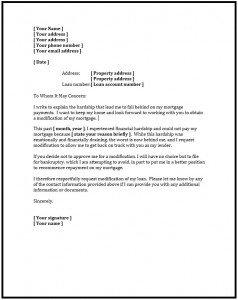
[Date]
[Servicer name]
Loss Mitigation Department
[Address from your servicer’s letter]Re: Hardship letter and loss mitigation application
Loan number: [number]
Property: [address]I am writing to request a [loan modification / repayment plan / forbearance / short sale / deed in lieu of foreclosure] on the loan above. I [intend to keep the property as my primary residence / am no longer able to keep the property and want to resolve the loan without a foreclosure].
In [month, year], [what happened: I lost my job at X / my hours were reduced from X to Y / I was hospitalized for X and out of work for Y weeks / my spouse and I separated and the household lost her income / my adjustable rate reset and the payment rose from X to Y]. As a result I fell behind on the mortgage beginning with the [month, year] payment. I am now [number] payments behind.
[If keeping the house:] My situation has changed. [I started a new position at X on date, earning Y per month / my hours were restored on date / my spouse returned to work on date.] My current monthly income is [amount], and the enclosed budget shows I can afford a payment of approximately [amount]. [If letting it go:] My income has not recovered, and I do not expect it to. I cannot afford this loan on any terms, and I am asking to resolve it through a [short sale / deed in lieu] rather than a foreclosure.
[Optional:] I am also reviewing my options with a bankruptcy attorney, including a Chapter 13 plan to cure the arrears.
My complete loss mitigation application is enclosed. Please contact me at [phone] or [email] if you need anything further.
[Signature]
[Printed name(s)]
Sample hardship letters by situation
The second and third paragraphs change with the facts. Here is how I frame the common ones, and here are full sample hardship letters for each situation.
Job loss, now re-employed. Date of the layoff, how long you were out, start date and pay at the new job. Ask for a modification. The servicer needs to see the income is back.
Hours or pay cut, still ongoing. The before-and-after numbers and whether your employer has given a timeline. If the cut is permanent, ask for a modification that fits the new income. If it is temporary with a known end date, forbearance may fit better. Here is how to decide between forbearance and a loan modification.
Medical. The diagnosis in one line, the dates you were out of work, and whether you are back. Attach nothing medical beyond what the servicer asks for. If the bills themselves are the problem, say so; that is a hardship the servicer understands.
Divorce or separation. The date the household income changed and what your income is now, on your own. If your former spouse is still on the loan, say who is living in the house and who is applying.
Death of a co-borrower. The date, and that you are the surviving borrower or the heir applying to keep the home. Servicers have a separate process for successors in interest, and the letter should say you are one.
Furlough or shutdown. The agency, the dates, and whether back pay is expected. Federal and contractor households in the DC area see this one often, and servicers here know it. Ask for forbearance if the pay is coming back, a modification if the contract ended.
What goes in the loss mitigation packet?
The letter rides along with the application. A packet is not complete until every item the servicer asked for is in it, and an incomplete packet does not get reviewed. Most servicers want:
- The servicer’s own application form, every page, signed and dated
- The hardship letter
- Your two most recent pay stubs, or a profit and loss statement if you are self-employed
- Your two most recent bank statements, all pages
- Your most recent federal tax return, signed, or a signed authorization for the servicer to pull a transcript
- Proof of any other income: Social Security, pension, rental income, support
- A monthly budget of income and expenses
- Proof of homeowners insurance and property taxes if they are not escrowed
- A signed authorization if anyone else, including a lawyer or housing counselor, is speaking to the servicer for you
Send everything at once. Send it the way the servicer says to, upload, fax or mail, and keep proof of when it went. Here is the full loss mitigation application checklist.
Why do hardship letters and packets get rejected?
Almost never for bad writing. They get rejected because something is missing, something does not match, or the timing was wrong.
Missing pages. A bank statement with page 3 of 4. A tax return without the signature page. The servicer sends a “missing documents” letter and the clock keeps running.
Numbers that do not line up. The letter says you earn one amount, the pay stubs show another, the budget shows a third. Reviewers check. Make the letter match the documents.
Asking for the wrong thing. Asking for a modification when the budget shows you cannot afford any payment, or asking for a short sale when you have equity. Decide what you are asking for before you write.
Sending it too late. Under federal servicing rules, a complete application received more than 37 days before a scheduled foreclosure sale generally stops the sale while it is reviewed. An application that arrives closer to the sale date may not. Timing is covered in Foreclosure Loss Mitigation.
I wrote more on the specific reasons in Top 6 Reasons Loan Modifications Are Denied.
Does the hardship letter stop the foreclosure?
Not by itself. A complete application, sent early enough, generally does, under the federal rules above. The letter alone does nothing.
If you have a sale date, do not count on the packet to save the house. In DC you can cure the default up to five business days before the sale, and bankruptcy stops a sale on filing in all three jurisdictions. Here is how to stop a foreclosure sale in DC and 7 ways to stop a foreclosure sale fast.
What should I do before I send it?
Have someone who reads these for a living look at the whole packet. Servicers reject packets over small errors, and a clean first submission beats trying to fix a rejected one.
I represent homeowners facing foreclosure in Washington DC and Northern Virginia, and I review hardship letters and full loss mitigation packages before they go out. For Maryland homeowners, I file Chapter 13 at the Greenbelt courthouse. Call me at (202) 448-5136 before you send yours. The consultation is free, and if a sale date is already on the calendar, call today.
Don’t wait. The servicer’s deadlines do not move because the packet is almost done.
They Called. They're Glad They Did.
Couldn’t have chosen a better attorney! He was extremely down-to-earth, explained everything clearly, and always made himself available whenever I had questions—even after my case was over. He helped me through a difficult financial situation and also helped put me in a better...

Thank you so much, for being an awesome lawyer. You took care of me and my husband when all the lawyer offices that we called did not answer or even seems to care, you stepped in and save the day. You listened to us and you took care of us as if we were family. You listened and...

Choosing Lee Legal to help me file for bankruptcy was the best decision I have made in a long time. Brian explained the entire process and answered every single question I posed. The mountain of building stress due to my situation lifted the second Brian walked me through the...

Brian Lee from Lee Legal was an amazing attorney to work with. He took his time, reviewed my documents and we discussed my situation thoroughly. He explained the process and my options as well as gave his recommendation. Not only did he assist, but he ensured that I knew this...

Brian is hands down the most amazing bankruptcy lawyer out there. he answered all my questions and even supported issues that arose 2 years after discharge Thank you for everything!!!!!!

Mr. Brian Lee made a stressful financial situation much easier to handle. Having a guide who is both deeply knowledgeable and approachable makes a massive difference when you are navigating financial challenges for the first time. THE BEST!!!

Search no more! Brian is trustworthy, friendly, attentive, and knowledgeable. Bankruptcy is never an easy decision to make however when it's time you'll need a good lawyer by your side. This is the man to do the job. I had zero hiccups throughout the entire process. Please do...

I was very nervous and scared about going through this process. But Brian was very knowledgeable and helped me through it. I was notified about any and all updates to my case and he was very responsive when I had questions regarding any concerns I had. Although a bit nerve...

I wanted to share my sincere appreciation for Brian and the support he provided during a very difficult time for my grandmother. We were not wealthy, but Brian treated us with genuine kindness and respect, making sure we felt comfortable throughout the entire process. He took the...

This is your last stop in your searches for an attorney. After numerous research and interview with many lawyers, I decided to hire attorney Brian Lee. He is extremely knowledgeable, personable, attentive and diligent. He went above and beyond to file my ch 7 bankruptcy and get a...

Brian provided me with a very detailed analysis about my potential case after our first consultation. He promptly responded to all my complex questions, especially navigating student loans and some tax discussions. He is very professional and experienced at what he does, I would...
