- Free Consultation: (202) 448-5136 Tap Here To Call Us




Do Not Defend Yourself in a Debt Collection Lawsuit


You have been served. Here is what to do in the first 48 hours, and why representing yourself in a debt collection lawsuit is usually the most expensive choice you can make.
What should I do when I get served?
Three things, in order.
Do not react. Process servers show up at home and at work. Take the papers, say nothing, and let them leave. Making a scene does not help your case, and nothing you say to the server helps either.
Read the whole complaint. Not just the first page. The plaintiff may have the wrong person, the wrong amount, or claims you did not expect. Scan every page, including the exhibits and the affidavit of service, because the defenses are often in the paperwork.
Call a lawyer before you do anything else. Do not file anything with the court, do not call the plaintiff’s lawyer, and do not contact the creditor. What you say and sign can be used against you.
Who files debt lawsuits in the DC region?
Credit card issuers, debt buyers, online lenders and landlords, mostly.
If you stop paying American Express, Discover or Capital One and they think you can pay, they sue. Debt buyers like Midland Credit Management and Portfolio Recovery Associates sue on accounts they bought from the banks. Online business lenders write their contracts so the case lands in Arlington General District Court no matter where you live, and landlords sue for the balance of a broken lease.
Every one of those plaintiffs has a lawyer. The question is whether you will.
Why do self-represented defendants lose?
Because the rules are the same for everyone, and the plaintiff’s lawyer knows them.
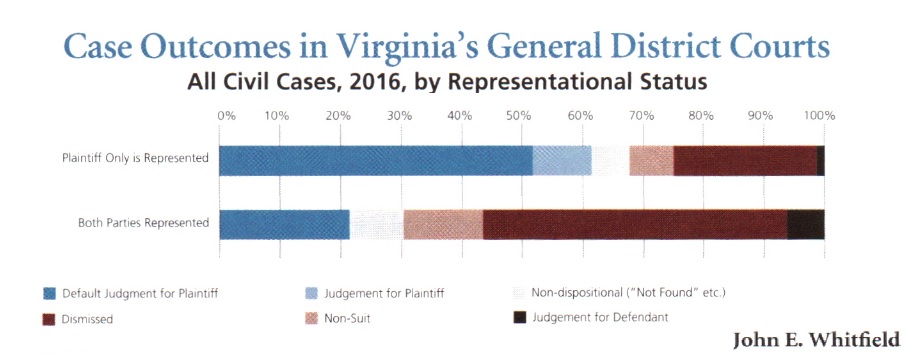
A Virginia legal aid study of general district court cases found that most civil cases involve at least one unrepresented party, and that represented parties win at substantially higher rates than unrepresented ones, on both sides of the case. Nothing about that is unique to Virginia.
The reasons are practical. A self-represented defendant misses a filing deadline and takes a default, or answers but never demands proof of the debt, or admits the debt on the record at the first hearing, or accepts the first settlement offer without knowing the plaintiff would have taken half.
Being right is not enough. You have to prove it under the court’s rules, on the court’s schedule.
What does a lawyer actually do in a debt case?
Four things that move the outcome.
Meets the deadlines. In DC you have 21 days to answer; in Maryland district court, 15 days to file a notice of intention to defend; in Virginia, a return date on the warrant. A missed deadline is a judgment.
Makes the plaintiff prove it. Debt buyers file boilerplate complaints and often cannot produce the chain of assignment or the account records. A lawyer asks for them, and plaintiffs that cannot deliver dismiss or settle.
Raises defenses you would not see. Statute of limitations, wrong party, miscalculated interest, FDCPA counterclaims.
Negotiates from knowledge. Knowing what a particular plaintiff accepts is what turns a full-balance demand into a discounted settlement. Here is how settlement works once you have been sued.
Is there ever a case I should handle myself?
If the amount is small enough that paying it costs less than a consultation, pay it and be done.
For anything else, the plaintiff did not spend money on a lawsuit over an amount it considers trivial. If it is worth suing over, it is worth defending properly.
What if I owe the debt and cannot pay it?
Then the lawsuit is a symptom. One judgment, garnished at up to 25 percent of your take-home pay, is bad enough. Several at once is unmanageable.
If this suit is one of several debts you cannot pay, a bankruptcy filing stops every one of them the day it is filed, including the garnishment that would follow a judgment. That is a conversation to have before the judgment, not after.
What should I do right now?
Do not freak out, and do not file anything. Find the response deadline on the papers and call me at (202) 448-5136 before it passes.
I represent defendants in debt collection cases in DC Superior Court and the Virginia general district courts of Arlington, Alexandria and Fairfax. The consultation is free.
Don’t walk into court alone.
They Called. They're Glad They Did.
Brian Lee from Lee Legal was an amazing attorney to work with. He took his time, reviewed my documents and we discussed my situation thoroughly. He explained the process and my options as well as gave his recommendation. Not only did he assist, but he ensured that I knew this...

Brian handled a legal matter for me and he was fantastic. He kept me informed of all updates and resolved all issues that were presented. I highly recommend Brian to all seeking legal advice and services.

I was very nervous and scared about going through this process. But Brian was very knowledgeable and helped me through it. I was notified about any and all updates to my case and he was very responsive when I had questions regarding any concerns I had. Although a bit nerve...

I've had the pleasure of working alongside Brian V. Lee for several years, and I can say without hesitation that he is one of the most knowledgeable bankruptcy attorneys in the DMV area. Brian's command of Chapter 7, 11, and 13 practice is exceptional, and his clients in the DC...

I wanted to share my sincere appreciation for Brian and the support he provided during a very difficult time for my grandmother. We were not wealthy, but Brian treated us with genuine kindness and respect, making sure we felt comfortable throughout the entire process. He took the...

Still several years from Public Service Student Loan Forgiveness and saddled with significant student loan payments in proportion to my income, I came to Lee Legal to explore the bankruptcy path. Through his counsel, Brian took the fear out of the process and helped me to...

Brian provided me with a very detailed analysis about my potential case after our first consultation. He promptly responded to all my complex questions, especially navigating student loans and some tax discussions. He is very professional and experienced at what he does, I would...

I had the opportunity to work with Brian at a time when I was challenged by a professional setback and forced with the challenge of making some very difficult legal decisions. Additionally, I worked with him again as I was dealing with some financial issues pertaining to my...

Brian has the amazing talent of taking complicated legal matters and distilling them down to seamless, frictionless resolutions. He is a phenomenal problem solver and a trusted advisor.

I came to Mr. Lee in a panic when I was experiencing health problems and the walls seemed to be closing in on me. Initially, I interviewed four attorneys seeking assistance with my situation. He was one of the most thorough and thoughtful people I’ve ever met. His kindness and...

Brian is both warm and professional. He helped me navigate a financial issue that I had not been looking forward to working on and he made the entire experience non-stressful, receiving a lot of anxiety I had around the matter. He is straight forward and a fantastic problem...

Brian is an amazing lawyer. He was referred to me by a friend who was also pleased with his work. I found him to be affordable, efficient, understanding, and easy to talk to. He really cares for his clients and is very committed to doing his best. He is very knowledgeable and...

This is your last stop in your searches for an attorney. After numerous research and interview with many lawyers, I decided to hire attorney Brian Lee. He is extremely knowledgeable, personable, attentive and diligent. He went above and beyond to file my ch 7 bankruptcy and get a...
